
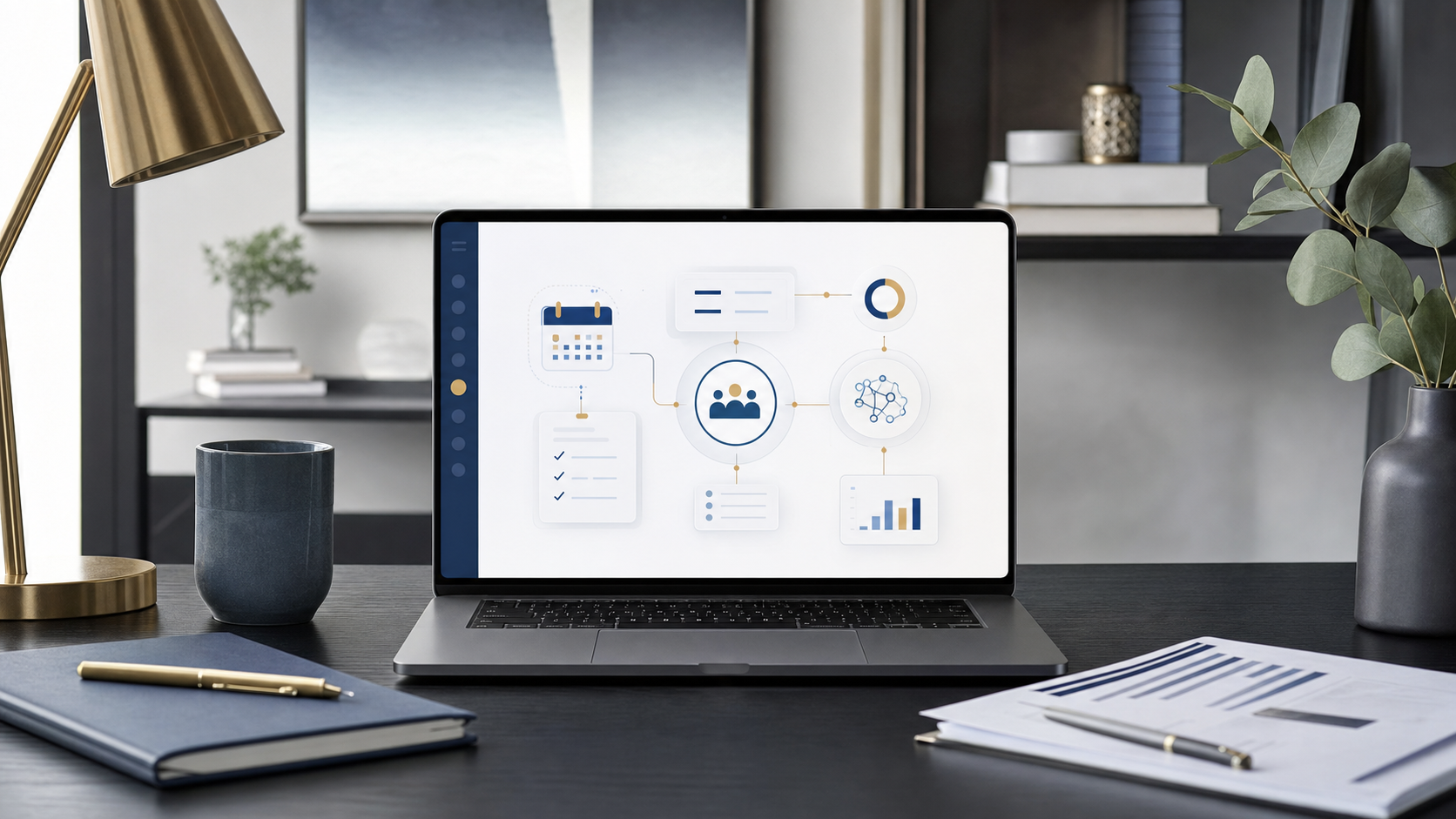
AI meeting prep for financial advisors is a practical way to recover time without making the client relationship feel automated. Before a review meeting, an advisor may need to pull CRM notes, portfolio context, open service items, prior commitments, planning documents, and recent communications into one usable brief. A focused AI workflow can organize that information, cite where it came from, flag missing context, and give the advisor more time to think about the conversation.
Lead-Lag Media® is an AI-driven sales, marketing, and distribution firm for the financial services industry. The same principle applies to advisor meeting preparation: AI handles the repetitive collection and organization, while the human advisor owns judgment, empathy, interpretation, and the final conversation. AI does the work. Humans make the connections.
Key Takeaways
- AI meeting preparation should create a source-linked brief, not an unsupervised recommendation or client-facing message.
- The best first use cases are structured: gathering prior notes, open tasks, approved data, and questions that need human attention.
- Every important statement needs a source, date, confidence label, and reviewer when it could influence a client conversation.
- A compliance-safe workflow separates data retrieval, summarization, drafting, approval, and recordkeeping.
- Advisors should pilot one meeting type, measure preparation time and follow-up quality, and expand only after exception handling works.
Why meeting preparation is an advisor capacity problem
A client meeting rarely begins when the calendar reminder appears. Preparation often means opening several systems, scanning recent email, checking the last meeting note, reviewing the portfolio, finding unfinished service requests, and remembering what the advisor promised to do. The work is important, but it is fragmented and easy to repeat.
That fragmentation creates two risks. First, an advisor spends valuable attention stitching together context instead of planning the conversation. Second, a material detail can be missed: an unanswered service request, a document that has not arrived, a change in a goal, or a question raised in the last interaction. A meeting brief should reduce those risks without pretending that a summary is the same thing as professional judgment.
AI is useful here because the inputs are often structured and the output can remain internal until a human reviews it. The workflow can collect approved records, normalize dates, separate facts from inferences, identify gaps, and prepare a concise agenda. It should not decide what the client should buy, promise a result, or turn unverified data into a recommendation.
What an AI meeting prep brief should contain
A good brief is short enough to review quickly and detailed enough to support a thoughtful conversation. It should make uncertainty visible instead of smoothing it away.
Relationship snapshot
Start with the household or relationship name, meeting type, last meeting date, stated objectives, service tier if relevant, and the people expected to attend. Use the firm’s approved CRM fields. If the household record is incomplete, label the missing information rather than filling it with a model-generated assumption.
Recent interactions and commitments
Summarize the last approved meeting note, recent messages, open tasks, and promises made by either side. Each item should show its date and source. Separate completed actions from unresolved items so the advisor can begin by closing the loop on what the client already asked for.
Portfolio and planning context
Where the firm has approved data connections, include a dated snapshot of the information the advisor is authorized to review: allocation, performance period, cash flows, planning milestones, and relevant account changes. Do not manufacture a narrative when data is stale or unavailable. A “data needs confirmation” flag is more useful than confident but unsupported commentary.
Conversation agenda
Suggest questions, not conclusions. For example, the brief can ask whether a cash-flow change is intentional, whether a goal timeline has moved, or whether the client still wants to discuss a previously deferred topic. The advisor decides which questions belong in the meeting and how to frame them.
Risk and exception flags
Highlight missing documents, contradictory notes, unusual account activity, incomplete records, potential privacy concerns, and topics that require a specialist or compliance review. An exception should route to a person. It should not be silently resolved by the model.
A five-step AI meeting preparation workflow
1. Trigger preparation from the calendar
Use the meeting type and timing to start the workflow. A quarterly review, prospect call, service meeting, and internal case conference should not produce identical briefs. Triggering preparation 24 to 48 hours ahead gives the advisor time to correct data or request a missing document.
2. Retrieve only permitted sources
Connect the workflow to firm-approved systems and define which fields it may read. Common inputs include CRM records, approved portfolio data, planning notes, prior meeting summaries, service tickets, and internal procedures. Keep access narrow and log the source used for each material statement.
3. Summarize with citations and labels
The summary should distinguish a verified fact, a client-stated preference, a system-derived value, an inference, and an unanswered question. Show the date of the source. If two records conflict, display the conflict and stop the workflow from turning it into a single “answer.”
4. Route the brief for review
A named reviewer should confirm that the brief is complete, relevant, and appropriate for the meeting. The reviewer can remove sensitive details, correct stale information, and mark questions for a planning specialist or compliance team. The review should be recorded before the brief is used.
5. Capture follow-up after the meeting
After the conversation, AI can structure notes, extract action items, assign owners, and draft a follow-up for review. The same source and approval controls apply. A meeting-prep workflow is most valuable when it closes the loop, rather than creating a polished brief that disappears after the meeting.
Compliance and privacy controls for advisor meeting prep
Meeting preparation uses relationship data, which makes governance part of the design. The exact controls depend on the firm’s business model, systems, vendors, and supervisory procedures, but a practical baseline includes the following:
- Data minimization: retrieve only the fields needed for the meeting type. Avoid sending unnecessary sensitive information to a model or third-party service.
- Access control: enforce role-based permissions and keep a record of who viewed, changed, approved, or exported a brief.
- Source and freshness checks: show the system and date for each material input, and hold the brief when data is stale or contradictory.
- No autonomous advice: do not allow the workflow to determine suitability, recommend a security, set an allocation, or promise performance.
- Human approval: require review before a brief influences a client-facing communication or any action that could affect an account.
- Retention: preserve the input references, generated brief, reviewer edits, final version, and follow-up record according to the firm’s retention policy.
- Stop conditions: pause for an access failure, privacy concern, client complaint, data conflict, unusual activity, or question outside the workflow’s approved scope.
The SEC investment adviser marketing guidance addresses misleading communications, performance information, endorsements, and recordkeeping. For broker-dealers, FINRA Rule 2210 sets standards for communications with the public, while FINRA Regulatory Notice 24-09 explains that existing obligations continue to apply when firms use generative AI. These sources do not turn an AI brief into a compliance solution, but they reinforce why supervision, evidence, and records belong in the workflow.
How advisors can measure the pilot
Do not evaluate AI meeting prep by how impressive the generated prose sounds. Measure whether the advisor is better prepared and whether the client experience improves.
| Metric | What to learn |
|---|---|
| Preparation time | How long the advisor spends reviewing and correcting the brief compared with the old process. |
| Brief exception rate | How often the workflow finds stale, missing, conflicting, or unauthorized information. |
| Open-item closure | Whether prior commitments and service requests are addressed more consistently. |
| Follow-up completion | Whether approved action items are assigned, tracked, and closed after the meeting. |
| Client experience | Whether clients report that conversations are more relevant, clear, and responsive. |
| Advisor adoption | Whether advisors trust the sources, understand the flags, and use the brief without bypassing controls. |
Lead-Lag Media® runs 80+ AI agents across content production, advisor outreach, meeting coordination, market intelligence, and deliverable reconciliation. Per the latest manual count, the firm delivered 48 financial advisor introductions in the last 30 days and 171 in the last 90 days. Those figures are operational context, not a promise of investment outcomes. They illustrate the value of tracking the handoff from organized information to a human conversation.
A 30-day implementation plan
Days 1-7: define the meeting and the boundary
Choose one meeting type, such as a quarterly review. List the systems and fields the advisor needs, the information that must remain out of scope, the reviewer responsible for approval, and the record that must be retained. Establish the baseline preparation time and recurring misses.
Days 8-14: build a read-only brief
Configure retrieval and summarization without client-facing sending or account changes. Add citations, source dates, conflict flags, and explicit “unknown” responses. Ask experienced advisors to score the briefs for accuracy and usefulness.
Days 15-21: add human-reviewed questions and actions
Introduce agenda questions, open-item routing, and post-meeting action extraction. Require a named reviewer to approve the brief before the meeting and to review any generated follow-up. Keep recommendation decisions and sensitive exceptions with the advisor or designated specialist.
Days 22-30: compare results and expand carefully
Review preparation time, exceptions, open-item closure, follow-up completion, and advisor feedback. Document what the workflow got wrong and which control caught it. Expand to another meeting type only when the first pilot has a reliable audit trail and clear ownership.
For the broader model, see the Lead-Lag Media® workflow overview. Financial advisors can explore the advisor engagement model, while issuers can review the issuer distribution workflow that connects useful information to human follow-up.
Further Reading
- NIST AI Risk Management Framework
- SEC: Investment Adviser Marketing
- FINRA Regulatory Notice 24-09: Generative Artificial Intelligence
Related Reading
- AI Referral Follow-Up for Financial Advisors: 2026 Guide
- Automated Lead Nurturing for Financial Advisors: 2026 Playbook
- Agentic AI for Financial Advisors: 2026 Implementation Guide
Frequently asked questions
What is AI meeting prep for financial advisors?
It is a supervised workflow that gathers approved relationship, portfolio, planning, and service information into a source-linked brief before a meeting. It supports preparation and follow-up; it does not replace professional judgment or make an autonomous recommendation.
What should an AI-generated meeting brief include?
Include the relationship snapshot, recent interactions, open commitments, dated planning and portfolio context, suggested questions, source links, uncertainty labels, and exception flags. The advisor should be able to see what is known, what is inferred, and what still needs confirmation.
Can AI meeting prep give investment advice?
It should not. The workflow can organize approved information and suggest questions for review, but the advisor and the firm’s supervisory process remain responsible for suitability, recommendations, disclosures, and client-facing decisions.
How should a firm start an AI meeting-prep pilot?
Choose one meeting type, build a read-only source-linked brief, require human approval, and measure preparation time, exception rates, open-item closure, and follow-up completion. Expand only after the firm can audit the workflow and explain who owns each decision.
Work with Lead-Lag Media®
Lead-Lag Media® is an AI-driven sales, marketing, and distribution firm for the financial services industry. More than 80 AI agents work for clients around the clock across content, outreach, coordination, intelligence, and reporting workflows. Humans make the connections, own approvals, and protect the relationship. See how the model works and use the walkthrough link there to start a conversation.
Michael A. Gayed, CFA is the founder of Lead-Lag Media®. 2x Charles H. Dow Award (CMT Association, 2014, 2016), 2x NAAIM Founders Award (2015, 2020), CFA Charterholder, Founder of Lead-Lag Media®.
Explore the Lead-Lag Media® AI-first financial services glossary for definitions of agentic AI, advisor engagement, AI-driven distribution, and financial advisor marketing automation.
About the author
Michael A. Gayed, CFA is the founder of Lead-Lag Media®, an AI-driven sales, marketing, and distribution firm for the financial services industry running 80+ AI agents plus two proprietary platforms — PodRadar for podcast intelligence and Atlas for advisor and institutional intelligence — for fund issuers and financial advisors. He is a two-time Charles H. Dow Award winner (CMT Association, 2014 and 2016) and two-time NAAIM Founders Award winner (2015 and 2020). He publishes The Lead-Lag Report on Substack (243,000+ subscribers), hosts Lead-Lag Live, and posts market commentary to @leadlagreport (770,000+ followers).