
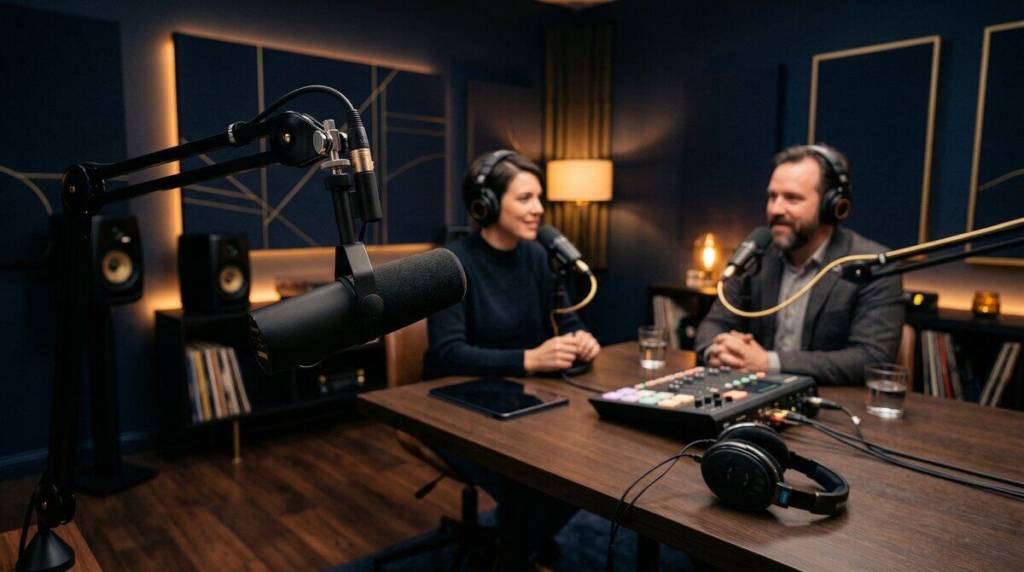
Every few years, a new marketing channel gets declared the future of financial services — email, then social media, then video, then webinars. Each has delivered results for early adopters, then leveled off as adoption became universal and competition eroded returns.
Podcasting is different. Not because it is new — it is not — but because the specific dynamics that make podcast appearances valuable for financial advisors are structural, not cyclical. Long-form trust, deep audience engagement, and credibility transfer from host to guest are not trends that go away when the next platform launches. They are rooted in human psychology.
This is why podcast marketing for financial advisors has moved from “nice to have” to the single highest-ROI visibility strategy available in 2026.
Key Takeaways
- Podcast listeners are among the most engaged audiences in media — 80% complete most or all episodes they start, giving guests 30–60 minutes of undivided attention.
- Credibility transfer is real — when a trusted host introduces you, their audience extends trust to you automatically.
- A single podcast appearance generates content that can be repurposed across LinkedIn, Twitter/X, newsletters, and YouTube for weeks.
- Pitching yourself strategically — with a clear angle and relevant talking points — is the difference between getting booked and getting ignored.
- Lead-Lag Media offers financial advisors free appearances on the Lead-Lag Live podcast, ranked in the top 1.5% globally, with an audience of active investors and financial professionals.
Why Podcasting Outperforms Every Other Advisory Marketing Channel
To understand why podcasting has become the dominant growth channel for financial advisors, you have to understand what makes it structurally different from every other content format.
Attention Is the Scarcest Resource in Marketing
The average social media post gets 3–7 seconds of attention. A display ad gets less than a second. An email, if you are lucky, earns 20 seconds. A podcast episode — in an audience that chose to listen — earns 40 to 60 minutes of focused, often screen-free engagement. That is not a marginal difference. It is a categorically different medium.
According to Edison Research’s 2025 Infinite Dial report, the U.S. now has approximately 109 million monthly podcast listeners. Among college-educated adults earning over $100,000 annually — a demographic that maps cleanly onto the high-net-worth client base financial advisors target — podcast listening rates are significantly above average.
The Trust Transfer Mechanism
When you appear as a guest on a podcast, something important happens that does not occur through any other channel: the host vouches for you. Implicitly, by having you on. Explicitly, by introducing you to their audience. Podcast listeners have typically listened to dozens or hundreds of episodes from a host they trust. When that host treats you as a credible peer worth hearing from, a portion of that trust is transferred to you in the minds of the audience.
This credibility transfer is not replicated by paid advertising, which audiences understand to be transactional. It is not replicated by social posts, which audiences know are self-promotional. It happens because the podcast context is editorial — the host chose you, and that choice signals endorsement.
Long-Form Engagement Reveals Depth
Soundbites cannot convey expertise. A 280-character tweet, a 30-second video clip, a one-paragraph LinkedIn post — these are signal-limited formats. You can demonstrate personality or spark curiosity, but you cannot demonstrate genuine analytical depth in a short-form medium.
A 45-minute podcast conversation is different. You can walk through your investment framework, explain how you think about risk across different client profiles, address misconceptions about a strategy you use, and show how you handle difficult client conversations. Depth is the differentiator — and podcasting is the only scalable channel that delivers it.
How to Get Booked: The Advisor’s Podcast Pitch Strategy
Most financial advisors who try podcast guesting give up after three or four unanswered pitch emails. The failure is almost never about credibility — it is about pitch construction. Podcast hosts and producers receive dozens of guest requests per week. The pitches that land are the ones that make the host’s job easy by being immediately clear about the value to their audience.
Identify the Right Shows
Start by cataloguing 20–30 podcasts that serve your target audience. This is not necessarily the largest shows — relevance matters more than reach. A 10,000-listener show whose audience is entirely composed of your ideal client profile is worth more than a 100,000-listener show with broad, unfocused demographics.
Research each show’s format, typical guest profile, and recurring topic areas. Listen to at least two episodes before pitching. Shows can tell when a pitch comes from someone who has never actually listened.
Craft a Compelling Pitch
A strong podcast pitch is concise, specific, and audience-focused. The structure that consistently works:
- One sentence on who you are and your most relevant credential or experience.
- Two or three specific talking points you can cover — framed as questions or insights that will benefit the host’s audience, not as descriptions of your practice.
- Social proof — previous podcast appearances, your Substack subscriber count, your LinkedIn following, or media mentions. Numbers matter.
- Why now — connect your topic to a current market development, regulatory change, or trend the audience is already thinking about.
Keep the pitch under 200 words. Producers do not read novels. If you cannot explain your value in four short paragraphs, the pitch needs more work.
Follow Up Once
Send one follow-up email seven to ten days after the initial pitch if you have not received a response. Keep it brief — a two-sentence check-in. After one follow-up, move on. Persistence in podcast pitching becomes quickly indistinguishable from spam.
Preparing for a High-Impact Podcast Appearance
Getting booked is half the battle. The other half is showing up prepared to deliver real value — because a strong podcast appearance earns you follow-on invitations, social media amplification from the host, and inbound inquiries from listeners. A mediocre one does none of those things.
Define Your Three Core Talking Points
Walk into every podcast appearance with three points you want the audience to take away. Write them down. They should be specific, insightful, and either surprising or actionable — ideally both. Vague talking points (“I help clients plan for retirement”) are forgettable. Specific ones (“Most advisors underestimate sequence-of-returns risk in the first five years of retirement — here’s what the data actually shows”) are memorable and shareable.
Use Stories, Not Just Data
Data persuades intellectually. Stories persuade emotionally. The advisors who resonate most on podcasts are the ones who weave client scenarios (anonymized), market history, and personal professional experiences into their answers. A story about a client who almost made a catastrophic withdrawal decision in March 2020 — and the conversation that prevented it — teaches the same lesson as a chart about panic selling, but it stays in the listener’s memory far longer.
Practice Answering Difficult Questions
Good podcast hosts probe. They will challenge your assumptions, ask about your biggest professional mistake, and push you on edge cases in your strategy. Advisors who hedge every answer with compliance-driven caution come across as evasive. Advisors who engage directly — acknowledging complexity, admitting uncertainty where it exists, and standing firm on points where they have conviction — come across as trustworthy.
Repurposing Podcast Content Across Channels
One of the most underutilized aspects of podcast guesting is content repurposing. A single 45-minute podcast appearance generates more reusable content than most advisors produce in a month of dedicated posting.
The Repurposing Matrix
- LinkedIn article — expand on your strongest talking point from the episode into a 600-word written piece with the podcast link embedded.
- Short-form clips — pull 60–90 second audio or video clips of your best moments. These perform exceptionally well on LinkedIn and Twitter/X, and many podcast platforms now make clip creation trivially easy.
- Quote graphics — a single strong sentence from the episode, rendered as a clean graphic, earns shares across all platforms.
- Email newsletter feature — send the episode to your client list with a paragraph on what you discussed and why it matters. This keeps existing clients engaged while positioning you as a thought leader.
- Twitter/X thread — the key insights from the episode, broken into a 7–10 tweet thread with a link to the full episode at the end.
Most advisors hit publish on one piece of content and move on. High-performing advisors treat each piece of original content as a source material that feeds five to ten derivative pieces. The leverage is enormous.
The Lead-Lag Live Advantage
Not all podcast audiences are created equal. The Lead-Lag Live podcast, hosted by Michael A. Gayed, CFA, reaches an audience of active investors, financial professionals, and market observers. Ranked in the top 1.5% of podcasts globally, the show has built a reputation for substantive, market-focused conversation that attracts serious listeners.
For financial advisors, an appearance on Lead-Lag Live checks every box: a credible, relevant host; a pre-qualified audience of financially sophisticated listeners; a track record of in-depth conversations; and significant social amplification through the show’s channels.
Through Lead-Lag Media’s free advisor program, financial advisors can access podcast appearances on Lead-Lag Live at no cost — part of a broader suite of marketing services that includes social media management and brand development support. For advisors who have been hesitant to invest in podcast marketing because of cost or uncertainty about how to start, this removes both barriers simultaneously.
Measuring the ROI of Podcast Appearances
Podcast marketing ROI is real but longer-cycle than paid advertising. The metrics worth tracking:
- LinkedIn profile views in the 30 days following an episode release — a reliable leading indicator of increased visibility.
- Inbound connection requests from people who mention the podcast in their message.
- Website traffic spikes on episode release days, particularly to your “about” or “contact” page.
- Discovery source in prospect intake forms — ask every new prospect how they found you. Podcast mentions compound over time.
Advisors who commit to two to three podcast appearances per quarter consistently report that, within 12 months, their inbound inquiry rate meaningfully increases and the quality of prospects — already educated, already trusting — improves alongside the quantity.
Start Your Podcast Marketing Strategy Today
Podcast marketing is not a trend — it is the most effective trust-building tool available to financial advisors in 2026. The advisors who begin building their podcast presence now are creating a compounding asset that will generate inbound clients, referral credibility, and speaking opportunities for years.
Apply for a free podcast appearance on Lead-Lag Live — in the top 1.5% of podcasts globally — and access a full suite of complimentary marketing services through Lead-Lag Media.
Michael A. Gayed, CFA, is the founder of Lead-Lag Media and publisher of The Lead-Lag Report on Substack.
Related Articles
- How Financial Advisors Can Build a Personal Brand (Without Spending a Dime)
- Financial Advisor Marketing Services: What Every Advisor Needs to Know in 2026
How Lead-Lag Media® runs podcast distribution at scale
Lead-Lag Media is an AI-driven sales, marketing, and distribution firm for the financial services industry. More than 80 AI agents handle podcast guesting, booking outreach, episode prep, and post-show distribution for our advisor and issuer network around the clock.
Learn more about our services for financial advisors, our work with fund issuers, or how our AI engine works end-to-end.
Related Reading
Frequently Asked Questions
Why is podcast marketing effective for financial advisors?
Podcast marketing works for advisors because it compounds trust. Prospects who listen to an advisor for 30+ minutes arrive at the first meeting pre-sold — they already know the advisor’s voice, opinions, and approach. Close rates on podcast-sourced leads run 2-3x higher than cold inquiries.
Should a financial advisor start their own podcast or be a guest?
Being a podcast guest has higher immediate ROI and lower effort. A single guest appearance on a relevant show can drive 20-50 qualified inquiries. Starting your own podcast makes sense once you have a repeatable content engine and a specific audience you own.
How does Lead-Lag Media help advisors with podcasts?
Lead-Lag Media books advisors as guests on Lead-Lag Live and partner podcasts, produces the full episode, and delivers short-form video clips for social media — all at no cost to the advisor. This turns one recording into weeks of content.